📘 Reference · information-oriented
Recurrence Types in DynVision
This document describes the different types of recurrent connections available in DynVision and their biological relevance.
Introduction to Recurrence
Recurrent connections are abundant in the primate visual system. In the ventral visual stream, lateral recurrent connections exist amongst neurons within a visual cortical region, and feedback connections go from higher areas (like V4) back to lower ones (such as V1).
DynVision implements several types of recurrent connections, each with different computational properties and biological interpretations.
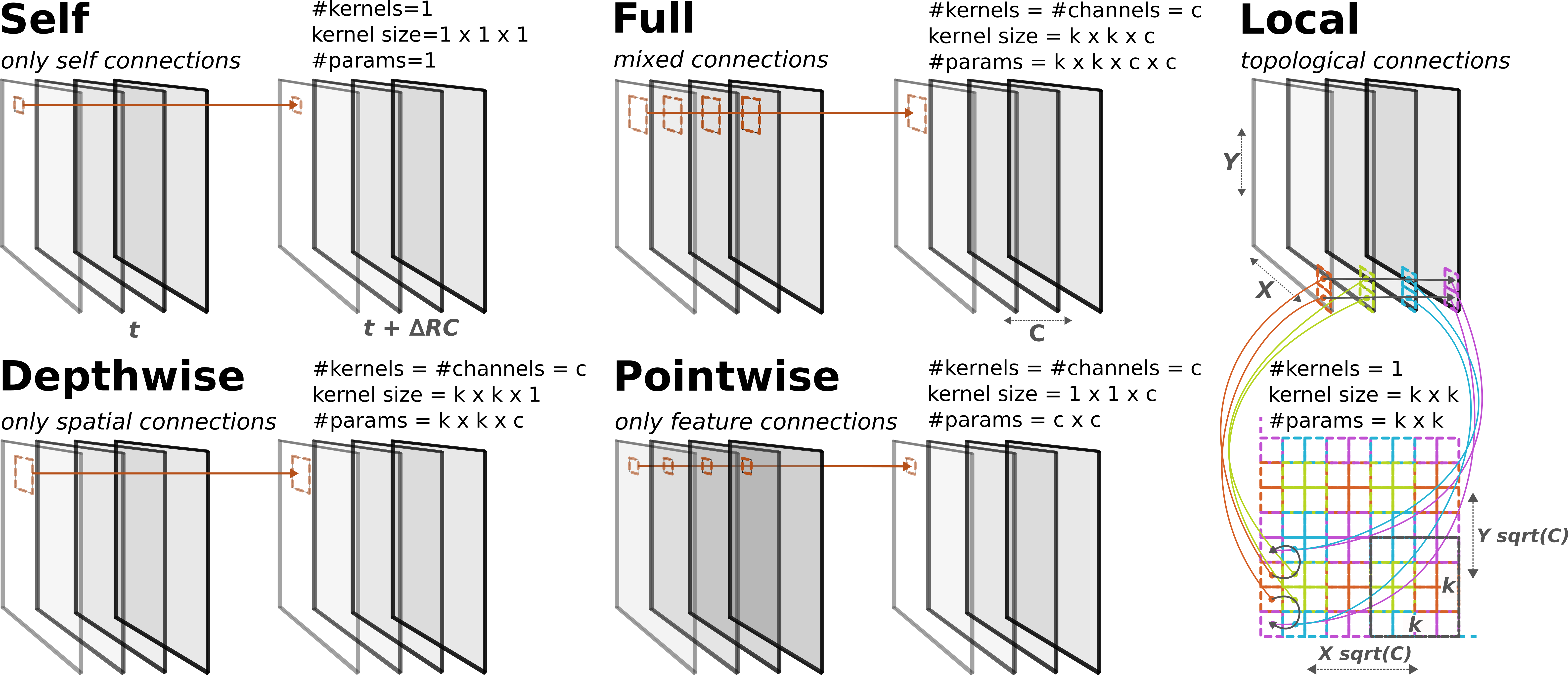
Available Recurrence Types
1. Self Recurrence
Self recurrence is the simplest form of recurrence, where a unit connects only to itself.
Illustration: See the Recurrence Types overview image at the top of this page.
Implementation Details:
- A layer's output tensor from a previous time step is multiplied with a weight and added to the current time step.
- Implemented in
SelfConnectionclass.
Biological Relevance:
- Models the persistence of neural activity over time.
- Can be interpreted as a simplified form of neural adaptation.
Usage Example:
from dynvision.models import DyRCNNx4

model = DyRCNNx4(
    recurrence_type="self",
    # other parameters
)
Computational Efficiency:
- Very efficient, as it only requires a scalar multiplication.
- Low parameter count, making it suitable for quick experiments.
2. Full Recurrence
In full recurrence, a unit gets input from all units within a nearby spatial region across all channels.
Illustration: See the Recurrence Types overview image.
Implementation Details:
- Implemented by applying a kernel convolution on the layer's output tensor and adding the outcome back to the same layer.
- Uses a full convolutional operation with a kernel size that determines the spatial extent of the recurrence.
- Implemented in
FullConnectionclass.
Biological Relevance:
- Models dense local connectivity within cortical areas.
- Captures both iso-feature and cross-feature interactions.
Usage Example:
from dynvision.models import DyRCNNx4

model = DyRCNNx4(
    recurrence_type="full",
    # other parameters
)
Computational Efficiency:
- More computationally expensive than self recurrence.
- Has O(C²K²) parameters, where C is the number of channels and K is the kernel size.
3. Depthwise Separable Recurrence
Depthwise separable recurrence applies a depthwise (spatial dimension) and then a pointwise (feature dimension) convolution instead of a full one.
Illustration: See the Recurrence Types overview image.
3.1 Depthpointwise Recurrence
Implementation Details:
- First applies a depthwise convolution (separate convolution for each channel).
- Then applies a pointwise convolution (1x1 convolution across channels).
- Implemented in
DepthPointwiseConnectionclass.
Biological Relevance:
- Models the idea that neurons first integrate information from the same feature type across space, then integrate across features.
Usage Example:
from dynvision.models import DyRCNNx4

model = DyRCNNx4(
    recurrence_type="depthpointwise",
    # other parameters
)
3.2 Pointdepthwise Recurrence
Implementation Details:
- Inverts the order of operations: first pointwise, then depthwise.
- Implemented in
PointDepthwiseConnectionclass.
Biological Relevance:
- Models the idea that neurons in visual cortex might first integrate across features at a single location, then spread that integration spatially.
Usage Example:
from dynvision.models import DyRCNNx4

model = DyRCNNx4(
    recurrence_type="pointdepthwise",
    # other parameters
)
Computational Efficiency:
- More efficient than full recurrence, with O(C² + CK²) parameters instead of O(C²K²).
- A good compromise between computational efficiency and representational power.
4. Local Recurrence
Local recurrence captures the 2-D topology of visual cortices by arranging units on a 2-D grid inspired by cortical organization.
Illustration: See the Recurrence Types overview image.
Implementation Details:
- Units in a layer are systematically arranged on a 2-D grid inspired by cortical organization.
- A convolution with kernel size > 1 is applied to this grid.
- Input to each unit is a combination of cortically-local feature and space information.
- Implemented in
LocalLateralConnectionclass.
Biological Relevance:
- Respects the topographic organization of visual cortex (e.g., orientation pinwheels in V1).
- Models how features that are close in feature space (e.g., similar orientations) interact more strongly.
Figure: Local recurrence maps the 3D activation tensor to a 2D cortical plane where nearby units have similar feature preferences. A convolution on this plane captures topographically organized lateral interactions.
Usage Example:
from dynvision.models import DyRCNNx4

model = DyRCNNx4(
    recurrence_type="local",
    # other parameters
)
5. Local Depthwise Recurrence
An extension of local recurrence that adds patchy long-range connections for more complex interactions.
Implementation Details:
- Combines local recurrence with an additional depthwise convolution.
- Models patchy long-range connections between units with different feature preferences but the same receptive field.
- Implemented in
LocalSeparableConnectionclass.
Biological Relevance:
- Models the patchy long-range lateral connections observed in visual cortex.
- These connections typically link cells with similar feature preferences across space.
Usage Example:
from dynvision.models import DyRCNNx4

model = DyRCNNx4(
    recurrence_type="localdepthwise",
    # other parameters
)
Computational Efficiency:
- Most computationally intensive of all recurrence types.
- Provides the most biologically realistic connectivity patterns.
Biological Plausibility Comparison
| Recurrence Type | Biological Plausibility | Computational Efficiency | Parameter Count |
|---|---|---|---|
| Self | Low | Very High | Very Low |
| Full | Medium | Low | High |
| Depthpointwise | Medium-High | Medium | Medium |
| Pointdepthwise | Medium-High | Medium | Medium |
| Local | High | Low | High |
| Localdepthwise | Very High | Very Low | Very High |
Implementation in RecurrentConnectedConv2d
All recurrence types are implemented within the RecurrentConnectedConv2d class, which serves as the main building block for recurrent layers in DynVision models.
Key parameters when configuring recurrence include:
recurrence_type: Type of recurrence to use ("self", "full", "depthpointwise", "pointdepthwise", "local", "localdepthwise")dt: Time step for simulation (in milliseconds)tau: Time constant for neural dynamics (in milliseconds)t_recurrence: Delay for recurrent connections (in milliseconds)delay_recurrence: Number of time steps to delay recurrent inputintegration_strategy: How recurrent input is combined with feedforward input ("additive" or "multiplicative")
Advanced Usage
Combining Multiple Recurrence Types
While not directly supported through a single parameter, you can create models with multiple recurrence types by manually configuring the layers:
import torch
from dynvision.model_components import RecurrentConnectedConv2d

# Create a layer with self recurrence
layer1 = RecurrentConnectedConv2d(
    in_channels=64,
    out_channels=64,
    kernel_size=3,
    recurrence_type="self"
)

# Create a layer with full recurrence
layer2 = RecurrentConnectedConv2d(
    in_channels=64,
    out_channels=64,
    kernel_size=3,
    recurrence_type="full"
)
Custom Recurrence Types
You can implement custom recurrence types by creating a new recurrence class and integrating it with RecurrentConnectedConv2d:
# in recurrence.py

# Define a custom recurrence type
class CustomRecurrence(RecurrenceBase):
    def __init__(self, in_channels, kernel_size, bias=False):
        super().__init__()
        # Implement your custom recurrence
        self.conv = nn.Conv2d(
            in_channels=in_channels,
            out_channels=in_channels,
            kernel_size=kernel_size,
            padding=kernel_size//2,
            bias=bias
        )

    def forward(self, x):
        return self.conv(x)
class RecurrentConnectedConv2d(ConvolutionalRecurrenceBase):
    def _setup_recurrence(self) -> None:
        # Map recurrence types to their implementations
        recurrence_types = {
            "self": lambda: SelfConnection(fixed_weight=self.fixed_self_weight),
            "custom": lambda: CustomRecurrence(in_channels=self.out_channels, **recurrence_params),
            # ... other recurrence types
        }
Performance Considerations
Recurrence types significantly impact both memory usage and computation time:
-
Memory Usage:
- Self recurrence has minimal memory overhead
- Full and local recurrence types require storing intermediate activations
- Depthwise separable recurrence types offer a middle ground
-
Computation Time:
- Self recurrence is fastest
- Local and localdepthwise recurrence are slowest
- For large models, consider using pointdepthwise or depthpointwise recurrence
-
Scaling with Image Size:
- Full recurrence scales quadratically with image size
- Depthwise separable types scale more efficiently
References
For more details on the biological inspiration behind these recurrence types, see:
- van Bergen & Kriegeskorte (2020). Going in circles is the way forward: The role of recurrence in visual inference.
- Liang & Hu (2015). Recurrent convolutional neural network for object recognition.
- Stettler et al. (2002). Lateral Connectivity and Contextual Interactions in Macaque Primary Visual Cortex.
- Ohki et al. (2006). Highly ordered arrangement of single neurons in orientation pinwheels.
- Spoerer, C. J., McClure, P., & Kriegeskorte, N. (2017). Recurrent Convolutional Neural Networks: A Better Model of Biological Object Recognition
- Qian, X., et al. (2024). Local lateral connectivity is sufficient for replicating cortex-like topographical organization in deep neural networks