📘 Reference · information-oriented
Model Architectures and Components
This reference documentation provides an overview of the model architectures available in DynVision and how they utilize different components to implement biologically-inspired vision models.
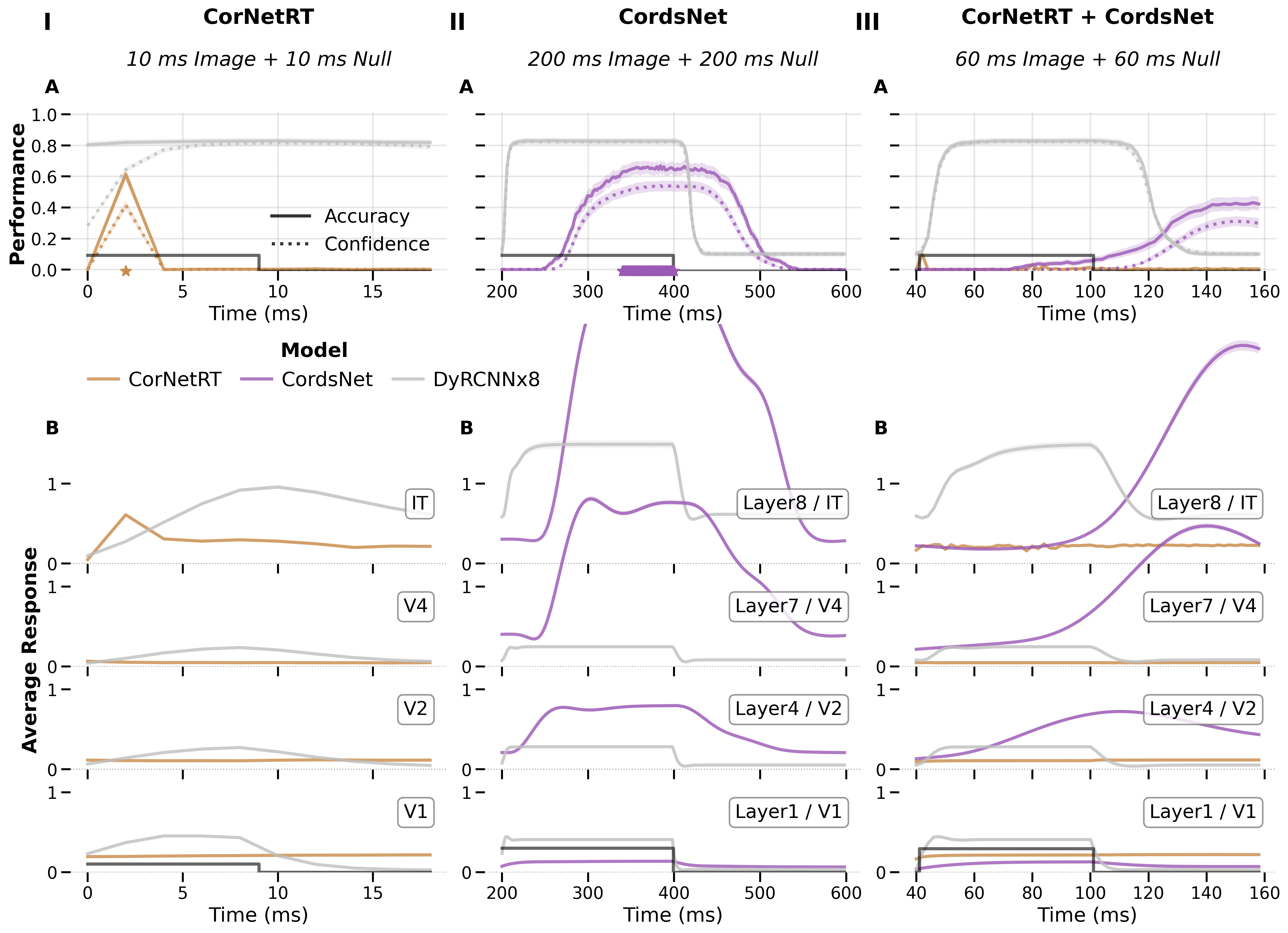
Figure: Equivalent reimplementation of CORnet‑RT and CordsNet in DynVision, alongside the native DyRCNNx8. The reimplementations are numerically equivalent to the originals while achieving up to 52% speedup.
Available Model Architectures
DynVision provides several model architectures, each serving different research purposes:
1. DyRCNN Family
The DyRCNN (Dynamic Recurrent CNN) family implements biologically-inspired vision models with continuous-time dynamics and recurrent connections.
DyRCNNx4
A four-layer architecture inspired by the ventral visual stream:
from dynvision.models import DyRCNNx4

model = DyRCNNx4(
    n_classes=10,                  # Number of output classes
    input_dims=(20, 3, 64, 64),   # (timesteps, channels, height, width)
    recurrence_type="full",      # Type of recurrent connectivity
    dt=2.0,                      # Integration time step (ms)
    tau=5.0                      # Neural time constant (ms) — default
)
Layer Organization:
- V1: Early visual processing with local feature extraction
- V2: Intermediate feature processing
- V4: Higher-order feature integration
- IT: Object recognition
Each layer implements:
- Feedforward convolution
- Recurrent connections
- Nonlinear activation
- Optional pooling
For details on recurrence types, see the Recurrence Types Reference.
2. Standard Architectures
DynVision includes implementations of standard architectures, enhanced with temporal dynamics:
ResNet with Dynamics
from dynvision.models import ResNet

model = ResNet(
    n_classes=1000,
    input_dims=(20, 3, 224, 224),
    version="50",                # ResNet version (18, 34, 50, 101)
    dynamics_solver="euler",     # Type of dynamics solver
    dt=2.0,
    tau=5.0
)
AlexNet with Dynamics
from dynvision.models import AlexNet

model = AlexNet(
    n_classes=1000,
    input_dims=(20, 3, 224, 224),
    dynamics_solver="euler",
    dt=2.0,
    tau=5.0
)
3. Research Models
CordsNet
from dynvision.models import CordsNet

model = CordsNet(
    n_classes=1000,
    input_dims=(20, 3, 224, 224),
    topographic=True,           # Enable topographic organization
    dt=2.0,
    tau=5.0
)
Model Comparison
DynVision enables systematic comparison of different recurrent architectures. The figure below compares training performance across reference models and DynVision variants trained on ImageNet:
Figure: Training comparison of reference RCNN implementations (CorNet-RT, CordsNet) and DynVision's DyRCNNx8 across ImageNet training. DynVision achieves faster training while supporting more biologically detailed architectures.
Component Integration
DynVision models are built from several key components, each documented in detail in their respective reference files:
1. Neural Dynamics
All models use continuous-time dynamics solvers to evolve neural activity:
from dynvision.model_components import EulerStep

# Example from DyRCNNx4
self.V1_dynamics = EulerStep(dt=self.dt, tau=self.tau_V1)
See Dynamics Solvers Reference for implementation details.
2. Recurrent Connections
Models can use various types of recurrent connectivity:
from dynvision.model_components import RecurrentConnectedConv2d

# Example from DyRCNNx4
self.V1_recurrent = RecurrentConnectedConv2d(
    in_channels=64,
    out_channels=64,
    kernel_size=3,
    recurrence_type="full",
    dt=self.dt,
    tau=self.tau
)
See Recurrence Types Reference for available patterns.
3. Layer Connections
Models can implement skip and feedback connections between layers:
from dynvision.model_components import Skip, Feedback

# Example skip connection
self.V1_V4_skip = Skip(
    in_channels=64,
    out_channels=256,
    scale_factor=4
)

# Example feedback connection
self.V4_V1_feedback = Feedback(
    in_channels=256,
    out_channels=64,
    scale_factor=0.25
)
4. Input Processing
Models typically start with a retina/LGN processing stage:
from dynvision.model_components import RetinaLGN

self.retina = RetinaLGN(
    in_channels=3,
    out_channels=64,
    kernel_size=7,
    stride=2
)
Model Configuration
Models are configured through a hierarchical configuration system:
# Example from config_defaults.yaml
model:
  name: DyRCNNx4
  args:
    dt: 2.0
    tau: 10.0
    recurrence_type: full
    store_responses: true
See Configuration Reference for details.
Creating Custom Models
To create custom models, inherit from appropriate base classes:
from dynvision.model_components import LightningBase

class CustomModel(LightningBase):
    def __init__(self, n_classes=1000, input_dims=(20, 3, 224, 224), **kwargs):
        super().__init__(n_classes=n_classes, input_dims=input_dims, **kwargs)
        self._define_architecture()

    def _define_architecture(self):
        # Define model architecture using components
        pass
See the Custom Models Guide for detailed instructions.
Best Practices
-
Model Selection:
- Use DyRCNN models for biological vision research
- Use enhanced standard architectures for comparison with literature
- Use research models for specific hypotheses
-
Component Configuration:
- Match time constants to biological values (typically 5-20ms)
- Choose recurrence types based on computational budget
- Use appropriate nonlinearities for biological plausibility
-
Performance Optimization:
- Use simpler recurrence types for large-scale training
- Consider mixed precision training
- Adjust batch sizes based on available memory
References
- Heeger, D. J., & Mackey, W. E. (2019). Oscillatory recurrent gated neural integrator circuits (ORGaNICs).
- Spoerer, C. J., McClure, P., & Kriegeskorte, N. (2017). Recurrent Convolutional Neural Networks: A Better Model of Biological Object Recognition.
- Nayebi, A., et al. (2018). Task-Driven Convolutional Recurrent Models of the Visual System.
- Kubilius, J., et al. (2019). CORnet: Modeling the Neural Mechanisms of Core Object Recognition.