📘 Reference · information-oriented
Layer Operations
This reference describes the configurable order of operations within each network layer, the reserved operation names, and how operations are dispatched during the forward pass.
Description
DynVision models define each layer as a sequence of operations executed in a
user-configurable order (the layer_operations list). This design lets you
control precisely where recurrent, skip, and feedback signals are integrated
relative to feedforward convolutions and the dynamics solver — without modifying
model code.
During each timestep, TemporalBase iterates over layer_names, and for every
layer it applies each entry of layer_operations in order.
Default Operation Order (DyRCNN)
The DyRCNN model family defines the following operation order
(dynvision/models/dyrcnn.py):
self.layer_operations = [
    "layer",         # apply the (recurrent) convolutional layer
    "addext",        # add external input
    "addskip",       # add skip connection
    "addfeedback",   # add feedback connection
    "tstep",         # apply the dynamical-systems ODE solver step
    "nonlin",        # apply the nonlinearity
    "supralin",      # apply the supralinearity
    "record",        # record activations in the responses dict
    "delay",         # set and get delayed activations for the next layer
    "pool",          # apply pooling
]
The base default in TemporalBase (dynvision/base/temporal.py) is the same but
additionally appends a "norm" (normalization) operation at the end. This
default is used only if a model does not define its own layer_operations.
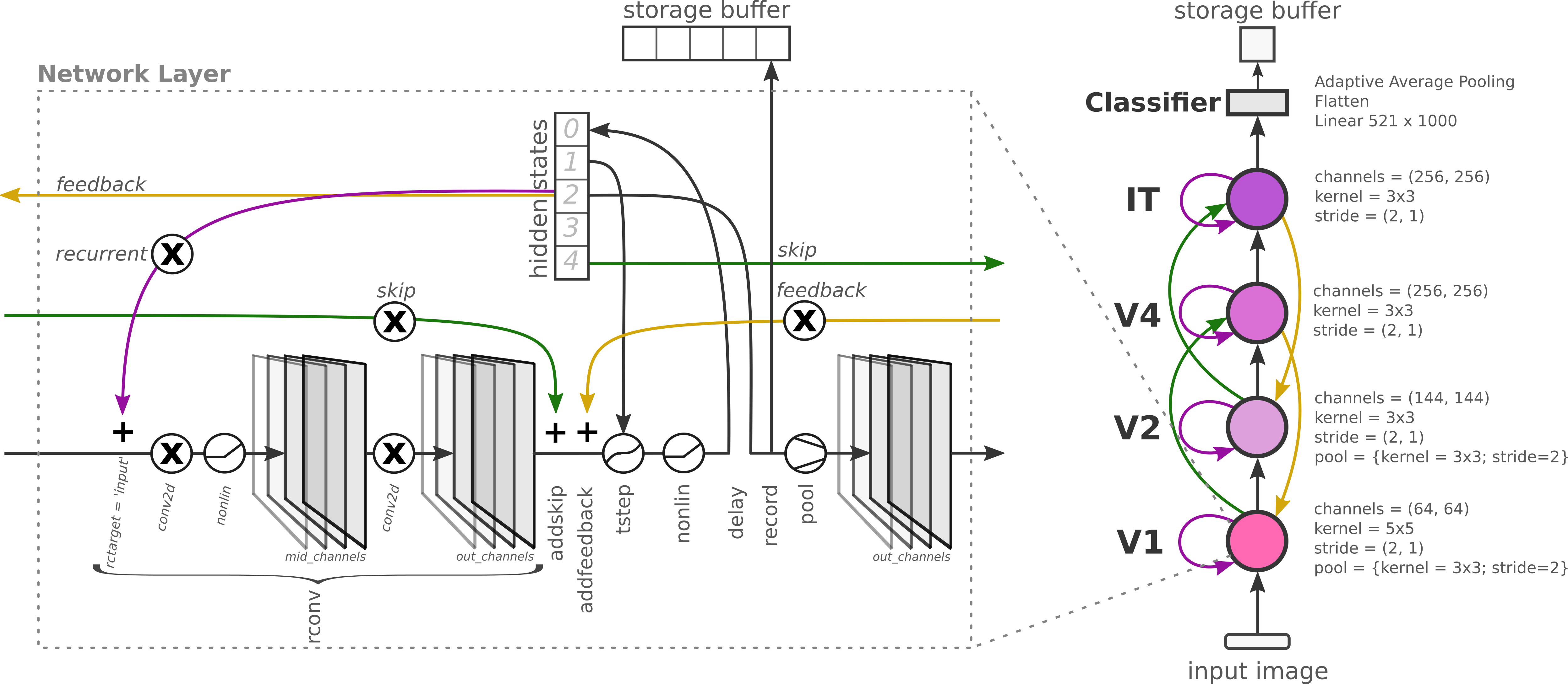
Figure: Architecture schematic of the DyRCNN model family. The left side shows the signal flow within one layer; the right side shows layer parameters and cross-layer connections. Feedforward, recurrent, skip, and feedback delays are indicated by pointers into hidden-state timestep slots.
Operation Dispatch and Naming Convention
For each operation, TemporalBase looks for a module or method named
{operation}_{layer_name} (layer-specific), and falls back to {operation}
(layer-unspecific). For example, tstep_V1 is the ODE solver for layer V1,
while nonlin is a single shared nonlinearity used by every layer.
If neither a layer-specific nor a shared implementation exists for an operation, that operation is silently skipped for that layer. This allows heterogeneous layer configurations without extra code paths.
Reserved Operation Names
The following operation names have dedicated handling in the forward pass:
| Name | Behaviour |
|---|---|
layer |
Applies the (recurrent) convolutional layer, passing feedforward_only through to it. |
tstep |
Applies the numerical ODE solver step, using the layer's newest hidden state. |
delay |
Writes the current activity into the hidden states and retrieves past activity with the correct feedforward delay. |
record |
Stores the current activity in the responses dictionary (only when response storage is active). |
All other operations (e.g. addext, addskip, addfeedback, nonlin,
supralin, pool, norm) are dispatched generically by name using the
convention above.
Conditional Operation Skipping
Two instance attributes control when operations are skipped:
-
non_feedforward_operations— operations skipped during afeedforward_onlyforward pass. Default:["addfeedback", "addskip"]. This isolates the pure feedforward pathway when measuring the contribution of recurrence. -
operations_skipped_on_null_input— operations skipped when the layer input isNone(a blank timestep). Default:["nonlin", "supralin", "pool", "norm"].
Both lists can be overridden per instance or subclass.
Adding Custom Operations
Each operation corresponds to a method or module attribute on the model. For
layer-specific operations use the naming convention
self.<operation>_<layer_name> = <module>; for layer-unspecific operations
(e.g. a shared nonlinearity) the _<layer_name> suffix can be omitted.
To insert a custom operation into the pipeline, add its name to
layer_operations at the desired position and define the corresponding
attribute in _define_architecture().