📘 Reference · information-oriented
Base Module Reference
The dynvision.base module provides the foundational classes for building biologically-inspired neural network models with PyTorch Lightning integration. This module implements a modular architecture that separates core neural network functionality, training infrastructure, storage management, and debugging capabilities.
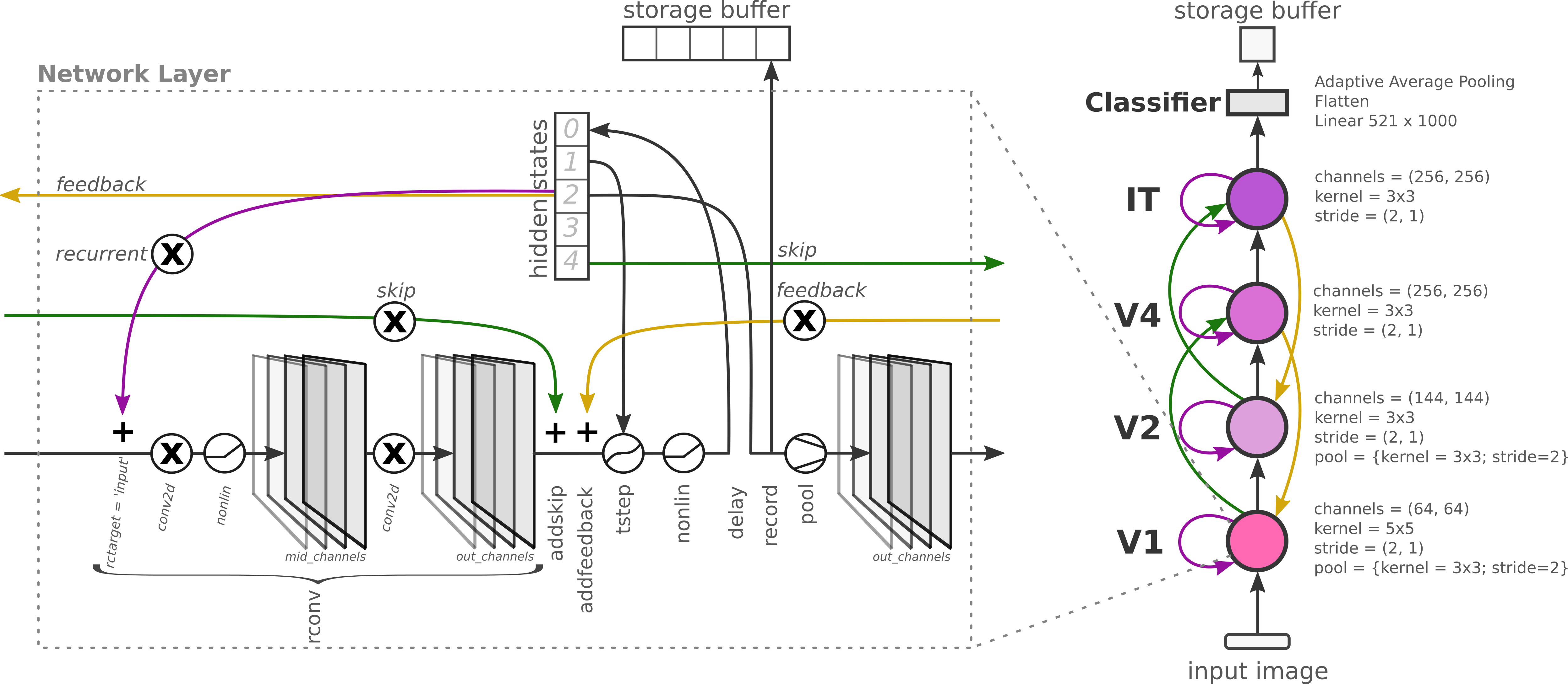
Figure: Architecture of the DyRCNN model family. Each layer receives feedforward input with configurable delays and recurrent input from its own past activity, with optional skip and feedback connections from other layers.
Overview
The base module is organized around five core components that can be used independently or combined through inheritance:
- Device/Dtype Coordination: Ensures consistent data types and device placement across model components
- Core Neural Network: Implements fundamental neural computation and architecture management
- Training Framework: Provides PyTorch Lightning integration for model training and evaluation
- Storage Management: Handles response storage and output management during training and testing
- Monitoring: Offers comprehensive debugging, logging, and performance monitoring capabilities
Module Components
BaseModel
The primary class that combines all functionality for typical use cases.
class BaseModel(
    TemporalBase,
    LightningBase,
    StorageBufferMixin,
    MonitoringMixin,
    DtypeDeviceCoordinatorMixin
)
Purpose: Complete neural network framework with training, storage, monitoring, and device coordination.
Parameters:
input_dims(Tuple[int]): Input tensor dimensions as (timesteps, channels, height, width). Default:(20, 3, 224, 224)n_classes(Optional[int]): Number of output classes. Can be inferred from data if not specifiedn_timesteps(int): Number of temporal processing steps. Default:1dt(float): Integration time step in milliseconds. Default:2.0tau(float): Neural time constant in milliseconds. Default:5.0learning_rate(float): Base learning rate for training. Default:0.001store_responses(int): Number of responses to store during training. Default:0**kwargs: Additional parameters passed to component classes
Key Methods:
_define_architecture(): Abstract method to implement model architectureforward(x): Forward pass through the networktraining_step(batch, batch_idx): PyTorch Lightning training stepconfigure_optimizers(): Optimizer and scheduler configuration
Example:
class MyModel(BaseModel):
    def _define_architecture(self):
        self.layer_names = ['conv1', 'conv2', 'classifier']
        self.conv1 = nn.Conv2d(3, 64, 3)
        self.conv2 = nn.Conv2d(64, 128, 3)
        self.classifier = nn.Linear(128, self.n_classes)

model = MyModel(
    input_dims=(20, 3, 64, 64),
    n_classes=10,
    learning_rate=0.001
)
TemporalBase
Core neural network functionality for biologically-inspired models.
Purpose: Implements fundamental neural network computation including forward passes, temporal dynamics, and parameter management.
Key Attributes:
input_dims(Tuple[int]): Processed input dimensionsn_classes(int): Number of output classesn_timesteps(int): Number of temporal processing stepsdt(float): Integration time step in millisecondstau(float): Neural time constant in millisecondslayer_names(List[str]): Names of network layers in processing orderdata_presentation_pattern(Union[str, List[int]]): Pattern controlling stimulus/null presentationshuffle_presentation_pattern(bool): Whether to shuffle pattern per batchloss_reaction_time(float): Reaction time window in milliseconds for loss maskingn_residual_timesteps(int): Residual timesteps for signal propagation
Temporal Presentation Parameters:
TemporalBase now handles sophisticated temporal presentation patterns and reaction time masking:
data_presentation_pattern: Controls which timesteps receive stimulus (1) vs null input (0)- String format:
"1011"or"1"(auto-expanded) - List format:
[1, 0, 1, 1] - Pattern length must divide evenly into
n_timesteps -
See Temporal Data Presentation Guide for details
-
shuffle_presentation_pattern: WhenTrue, randomly permutes pattern per batch - Shuffles base pattern before resampling to
n_timesteps - Maintains chunk durations after shuffling
-
Provides temporal variability during training
-
loss_reaction_time: Masks labels after stimulus onset (in milliseconds) - Converts to timesteps:
ceil(loss_reaction_time / dt) - Applied per stimulus chunk (not just first timestep)
- Warnings issued when reaction window exceeds chunk duration
-
non_label_index: Label value for masked timesteps (default: -1) non_input_value: Input value for null timesteps (default: 0.0)
Loss Configuration:
TemporalBase owns loss criterion initialization through _init_loss():
- Supports multiple loss functions with configurable weights
- Automatically registers hooks for ActivityLoss
- Handles
ignore_indexconfiguration for temporal masking - See Loss Functions Reference for available losses
Core Methods:
_define_architecture() -> None
Abstract method that must be implemented by subclasses to define the network architecture.
Raises: NotImplementedError if not implemented in subclass
forward(x_0: torch.Tensor, store_responses: bool = False, feedforward_only: bool = False) -> torch.Tensor
Forward pass through the network over all timesteps.
Parameters:
x_0(torch.Tensor): Input tensor with shape (batch, timesteps, channels, height, width)store_responses(bool): Whether to store intermediate responses. Default:Falsefeedforward_only(bool): Whether to disable recurrent connections. Default:False
Returns: torch.Tensor with shape (batch, timesteps, n_classes)
set_residual_timesteps(n_timesteps: Optional[int] = None, max_timesteps: int = 100) -> None
Set or automatically determine the number of residual timesteps required for signal propagation.
Parameters:
n_timesteps(Optional[int]): Explicit number of residual timestepsmax_timesteps(int): Maximum timesteps to check during automatic determination
Example:
class CoreModel(TemporalBase, DtypeDeviceCoordinator):
    def _define_architecture(self):
        self.layer_names = ['layer1', 'layer2']
        self.layer1 = nn.Conv2d(3, 64, 3)
        self.layer2 = nn.Conv2d(64, 10, 3)
        self.classifier = nn.AdaptiveAvgPool2d(1)

model = CoreModel(input_dims=(10, 3, 32, 32))
LightningBase
PyTorch Lightning integration for training and evaluation.
Purpose: Provides PyTorch Lightning training framework integration including loss computation, optimization, and training loops.
Key Parameters:
optimizer(str): Optimizer class name fromtorch.optim. Default:"Adam"learning_rate(float): Base learning rate. Default:0.001scheduler(str): Learning rate scheduler name. Default:"StepLR"criterion_params(List[Tuple[str, Dict]]): Loss function specificationslog_every_n_steps(int): Frequency of parameter logging. Default:50
Core Training Methods:
training_step(batch: Tuple[torch.Tensor, torch.Tensor], batch_idx: int) -> torch.Tensor
Single training step implementation.
Parameters:
batch(Tuple): Input data and labelsbatch_idx(int): Batch index
Returns: torch.Tensor containing the loss value
validation_step(batch: Tuple[torch.Tensor, torch.Tensor], batch_idx: int) -> torch.Tensor
Single validation step implementation.
Parameters:
batch(Tuple): Input data and labelsbatch_idx(int): Batch index
Returns: torch.Tensor containing the loss value
test_step(batch: Tuple[torch.Tensor, torch.Tensor], batch_idx: int) -> torch.Tensor
Single test step implementation.
Parameters:
batch(Tuple): Input data and labelsbatch_idx(int): Batch index
Returns: torch.Tensor containing the loss value
configure_optimizers() -> Dict[str, Any]
Configure optimizers and learning rate schedulers with parameter grouping.
Returns: Dictionary containing optimizer and scheduler configurations
backward(loss: torch.Tensor, optimizer: Any = None, optimizer_idx: int = 0) -> None
Perform backward pass with optional retain_graph for gradient computation.
Parameters:
loss(torch.Tensor): Loss value to backpropagateoptimizer(Any): Optimizer instance (provided by Lightning)optimizer_idx(int): Optimizer index for multi-optimizer setups
PyTorch Lightning Hooks:
LightningBase implements several PyTorch Lightning lifecycle hooks:
on_fit_start(): Called at the beginning of fiton_train_start(): Called at the beginning of trainingon_train_end(): Called at the end of trainingon_validation_start(): Called at the beginning of validationon_validation_epoch_end(): Called at the end of validation epochon_test_start(): Called at the beginning of testingon_train_batch_start(batch, batch_idx, dataloader_idx): Called before each training batchon_validation_batch_start(batch, batch_idx, dataloader_idx): Called before each validation batchon_train_batch_end(outputs, batch, batch_idx, dataloader_idx): Called after each training batchon_before_optimizer_step(optimizer, optimizer_idx): Called before optimizer step
Example:
class TrainingModel(TemporalBase, LightningBase):
    def _define_architecture(self):
        # Define architecture
        pass

model = TrainingModel(
    optimizer="SGD",
    learning_rate=0.01,
    scheduler="CosineAnnealingLR"
)
StorageBuffer and StorageBufferMixin
Response and output storage management.
class StorageBuffer:
    """Core storage functionality"""

class StorageBufferMixin(StorageBuffer):
    """Storage with PyTorch Lightning hooks"""
Purpose: Manages storage of neural responses, outputs, and metadata during training and evaluation.
Key Methods:
get_responses() -> Dict[str, torch.Tensor]
Retrieve stored neural responses.
Returns: Dictionary mapping layer names to response tensors
get_dataframe(layer_name: str = "classifier") -> pd.DataFrame
Generate a pandas DataFrame with classifier responses and metadata.
Parameters:
layer_name(str): Name of classifier layer
Returns: pd.DataFrame with columns for responses, labels, predictions, and metadata
Monitoring and MonitoringMixin
Debugging and performance monitoring utilities.
class Monitoring:
    """Core monitoring functionality"""

class MonitoringMixin(Monitoring):
    """Monitoring with PyTorch Lightning hooks"""
Purpose: Provides comprehensive debugging, logging, and performance monitoring capabilities.
Key Methods:
log_param_stats(section: str = "params", metrics: List[str] = ["min", "max", "norm"]) -> None
Log statistics of model parameters.
Parameters:
section(str): Section name for loggingmetrics(List[str]): Statistics to compute and log
_check_weights(raise_error: bool = False) -> None
Check model weights for NaN/Inf values and dtype consistency.
Parameters:
raise_error(bool): Whether to raise exception on detection of issues
DtypeDeviceCoordinator and DtypeDeviceCoordinatorMixin
Device and dtype coordination across model components.
class DtypeDeviceCoordinator:
    """Core coordination functionality"""

class DtypeDeviceCoordinatorMixin(DtypeDeviceCoordinator):
    """Coordination with PyTorch Lightning hooks"""
Purpose: Ensures consistent data types and device placement across all model components with persistent state.
Key Methods:
create_aligned_tensor(*args, **kwargs) -> torch.Tensor
Create tensors with correct dtype and device for the coordination network.
Parameters:
size(Tuple[int]): Tensor dimensionscreation_method(str): Tensor creation method ("randn", "zeros", "ones"). Default:"randn"**kwargs: Additional tensor creation parameters
Returns: torch.Tensor with appropriate dtype and device
propagate_dtype_sync() -> None
Synchronize dtype and device across all coordinated components.
Alternative Compositions
For advanced users who need specific functionality combinations:
CoreModel
class CoreModel(TemporalBase, DtypeDeviceCoordinator):
    """Neural network with device coordination only"""
MonitoredModel
class MonitoredModel(TemporalBase, Monitoring, DtypeDeviceCoordinator):
    """Neural network with monitoring but no Lightning integration"""
LightningOnlyModel
class LightningOnlyModel(TemporalBase, LightningBase, MonitoringMixin):
    """Training framework without automatic storage"""
Usage Patterns
Basic Model Development
from dynvision.base import BaseModel

class MyNeuralNetwork(BaseModel):
    def _define_architecture(self):
        self.layer_names = ['input', 'hidden', 'output']
        self.input = nn.Conv2d(3, 64, 3)
        self.hidden = nn.Conv2d(64, 128, 3)
        self.output = nn.Conv2d(128, self.n_classes, 1)
        self.classifier = nn.AdaptiveAvgPool2d(1)

# Instantiate with full functionality
model = MyNeuralNetwork(
    input_dims=(20, 3, 64, 64),
    n_classes=10,
    learning_rate=0.001,
    store_responses=1000
)
Research-Focused Development
from dynvision.base import CoreModel, Monitoring

class ResearchModel(CoreModel, Monitoring):
    def _define_architecture(self):
        # Minimal setup for experimentation
        pass

# No Lightning overhead, just core functionality
model = ResearchModel(input_dims=(5, 1, 28, 28))
Custom Lightning Integration
from dynvision.base import TemporalBase, LightningBase

class CustomTrainingModel(TemporalBase, LightningBase):
    def _define_architecture(self):
        # Custom architecture
        pass

    def training_step(self, batch, batch_idx):
        # Custom training logic
        return super().training_step(batch, batch_idx)
Implementation Notes
Method Resolution Order (MRO)
The inheritance order in BaseModel ensures proper method resolution:
TemporalBaseprovides core neural network methodsLightningBasecan call DynVision methods in training steps- Storage and monitoring mixins add Lightning hooks
- Device coordination ensures consistency across all components
Parameter Flow
- Core neural network parameters are handled by
TemporalBase - Training configuration is managed by
LightningBase - Component-specific parameters are stored by respective classes
- All classes accept
**kwargsfor flexible parameter passing
Memory Management
- Storage components automatically manage memory usage
- Device coordination ensures optimal tensor placement
- Monitoring tools help identify memory leaks and performance issues
Related Documentation
- Getting Started Guide - Basic usage tutorial
- Custom Models Guide - Creating custom architectures
- Model Testing Guide - Testing and evaluation
- Temporal Data Presentation - Temporal features and patterns
- Loss Functions Reference - Loss configuration and behavior
- Configuration Reference - Configuration system documentation